Type of Facility and Location:
- A pharmaceutical manufacturing facility in New Jersey.
Primary Issues:
- The mechanical system servicing the manufacturing space could no longer maintain the proper temperature and humidity levels necessary for ongoing operations.
- Provided a system performance restoration in order to avoid a $500,000 replacement capital expense, and costs associated with a lengthy operational downtime of system replacement.
Type of System:
- The mechanical system included a single 100-ton HEPA-filtered AHU with an 8-row coil approximately 4 ft. by 8 ft.
- The dedicated air-cooled chiller plant sat directly adjacent to the AHU and was powered by a 480-volt 3-phase bus.
Pre-cleaning Condition of System:
- The ambient type of particulate was a fine powder.
- The chilled water coil appeared to be visibly clear.
- There were multiple banks of Merv 8 and Merv 12 filtration in front of the coil and a bank of HEPA downstream from the coil.
- However, airflow testing across the coil confirmed several blockages that were greatly affecting unit performance.
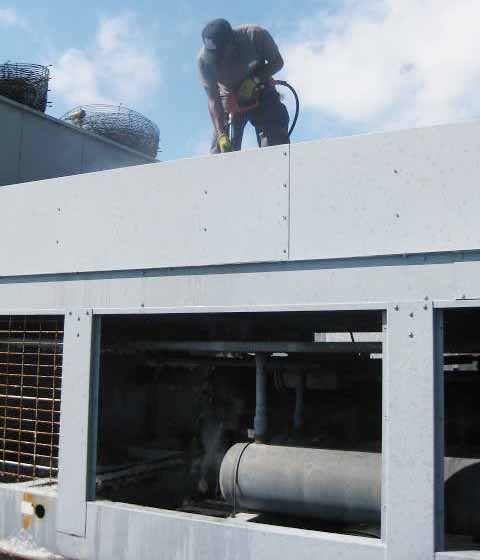
- The chiller plant itself showed heavy contamination in the condenser coils and was constantly running all four compressors with high head pressure to achieve a 41-degree chilled water output temperature.
Services Performed:
- Both the chilled water coil inside the AHU and the bank of condenser coils for the chiller plant were cleaned with the patented Biomik Process, which incorporates:
- Multiple alternating courses of high-pressure “wet steam” and Biomik Coil Cleaner.
- A post-cleaning Biomik Protective Coil Spray is applied.
Results:
- There was an immediate and drastic improvement in system performance and efficiency.
- There were gains in all psychometric values of airflow, temperature, and humidity, which resulted in a 26% increase in BTU output.
- Simultaneously, there was a 9% drop in chiller plant electric draw.
- Head pressure also dropped to produce the 41-degree chilled water output.
- The resultant water temperature was now greatly over-cooling the manufacturing space to the point of worker discomfort, and so the set point was moved to 44 degrees.
- Each increase of one degree of the setpoint is equal to 2.5%-3% drop in energy consumption by the chiller plant.
Savings:
- A $500,000 equipment replacement capital expenditure project was avoided.
- Proper environmental conditions in the manufacturing space were restored, preventing losses from poor product quality through insufficient environmental conditions.
- A 16.5%-18% energy savings on the system operation was established moving forward, which equals $7,902.00 at standard NJ rates.